
In this post, you will discover:
- 🌟 Stunning fur colors and unique appearance of sifakas
- 🤸♂️ Their amazing leaps and sideways hopping moves
- 🥬 What they eat and how they live in family groups
- 🌳 The habitats they call home and conservation efforts to protect them
- ❓ Answers to top questions: where to see them, diet, and endangered status
Discover the enchanting sifakas of Madagascar—lemurs known for their striking fur, incredible leaps, and fascinating social behavior. In this article, you will learn about their unique movements, diet and habitat, social life, reproductive behavior, evolution, and the conservation efforts working to protect these extraordinary primates.
Unique Appearance and Graceful Movements
Sifakas are one of Madagascar’s most iconic and captivating primates. Belonging to the genus Propithecus, these lemurs are renowned for their striking appearance, graceful movements, and unique social behaviors. Found exclusively on the island of Madagascar, sifakas are a vivid example of the incredible biodiversity that makes this island a conservation hotspot.
One of the most remarkable features of sifakas is their distinctive mode of locomotion. Unlike other lemurs that often move quadrupedally along branches, sifakas are famous for their powerful vertical leaps. Using their strong hind limbs, they can jump distances of up to 10 meters between trees, gliding through the forest with an almost balletic elegance. On the ground, sifakas exhibit a characteristic sideways hopping motion, holding their arms up for balance, which has become an endearing and iconic image of Madagascar’s wildlife.
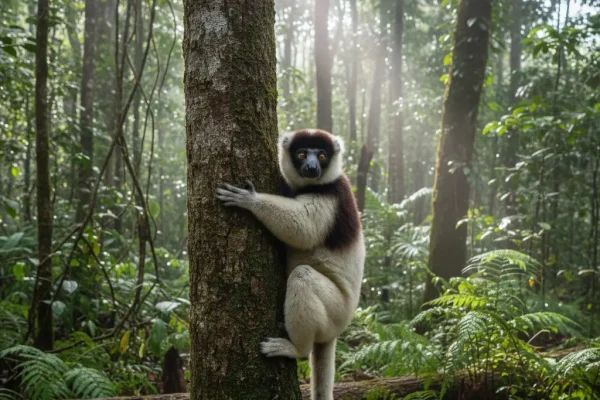
Visually, sifakas are highly recognizable. Their fur can vary widely in color, from creamy white to golden, brown, or even black, depending on the species. Some species, such as the Verreaux’s sifaka (Propithecus verreauxi), are entirely white with dark faces, while others like the diademed sifaka (Propithecus diadema) have more intricate patterns of golden, gray, and black. Most sifakas have contrasting faces, often dark or black, set against lighter body fur, which highlights their expressive eyes and distinctive features. This striking appearance, combined with their dramatic leaps, makes them a favorite among wildlife photographers and tourists exploring Madagascar’s forests.
Their long, powerful legs and strong tail assist in balance during leaps and agile movement in the trees. Unlike monkeys, sifakas cannot swing from their arms; instead, they rely entirely on vertical clinging and leaping to navigate the canopy. Watching a sifaka leap from branch to branch is a truly mesmerizing experience that illustrates both their physical prowess and evolutionary specialization.
Diet, Habitat, and Social Life
Sifakas are primarily folivorous, meaning they feed mainly on leaves, but their diet can also include flowers, fruits, bark, and seeds. Their specialized digestive systems allow them to extract nutrients efficiently from a variety of plant materials, some of which are tough or mildly toxic to other animals. This dietary adaptability helps them survive in the diverse habitats of Madagascar, from dry deciduous forests in the west to humid rainforests in the east.
Some species are highly selective, preferring certain tree species for their food, which makes habitat preservation critical. Seasonal changes also affect their diet; during the dry season, they may rely more on leaves and bark, while in the wet season, flowers and fruit become more abundant.
Socially, sifakas live in small family groups, typically consisting of 3 to 10 individuals. These groups maintain strong bonds through grooming, vocalizations, and cooperative care of young. Sifakas communicate using a complex system of calls, ranging from alarm signals when predators are nearby to soft chattering sounds that reinforce group cohesion. Females are generally dominant over males, a social structure common among lemurs, which influences access to food and reproductive opportunities.
Group life is essential for sifakas’ survival. Grooming not only strengthens social bonds but also helps reduce parasites. Young sifakas learn essential survival skills by observing and imitating older group members. This social learning is crucial, as it teaches them which trees are safe for feeding and how to navigate the canopy efficiently.
Reproduction and Life Cycle
Sifakas are seasonal breeders, with mating usually occurring during the austral summer (November to February). Females give birth to a single infant after a gestation period of approximately 4.5 to 5 months. The infant clings to the mother’s belly for the first few weeks, eventually transitioning to riding on her back as it grows stronger.
Infant sifakas are highly dependent on their mothers, receiving both nourishment and protection during their early months. The strong social structure of sifaka groups ensures that young lemurs are cared for and learn essential survival skills from other group members. Juveniles begin to explore the canopy on their own around 3 to 4 months old, gradually developing the agility needed to leap from tree to tree.
Life expectancy in the wild ranges from 15 to 20 years, depending on species and habitat conditions. Predation, habitat loss, and hunting are the primary threats to their longevity in the wild.
Evolution and Ecological Role
Sifakas are part of Madagascar’s remarkable evolutionary story. Lemurs arrived on the island around 50 to 60 million years ago and diversified into numerous species, each adapted to specific ecological niches. Sifakas’ powerful leaping ability and folivorous diet are examples of evolutionary specialization unique to Madagascar.
Ecologically, sifakas play an important role in seed dispersal and forest regeneration. By consuming fruit and moving through large areas of forest, they help spread seeds far from the parent trees, promoting biodiversity and healthy ecosystems. Their feeding behavior also influences the structure of the forest, as selective browsing can affect which plant species thrive.
Conservation Challenges and Efforts
Unfortunately, sifakas face numerous conservation challenges. Deforestation, slash-and-burn agriculture, and hunting have caused population declines, and some species are now listed as endangered. Protected areas and national parks, such as Anja Community Reserve, Andasibe-Mantadia National Park, and Berenty Reserve, play a crucial role in safeguarding their habitats.
Conservation organizations are engaging local communities in sustainable practices and environmental education. Ecotourism, when managed responsibly, provides economic incentives for communities to protect sifakas and their habitats. Captive breeding programs also contribute to the survival of critically endangered species, with the goal of eventually reintroducing them into secure natural habitats.
Protecting sifakas is essential not only for maintaining biodiversity but also for preserving the cultural and natural heritage of Madagascar. These lemurs are a symbol of the island’s uniqueness and a reminder of the delicate balance of tropical ecosystems.
Frequently Asked Questions
Where can I see sifakas in Madagascar?
Sifakas can be seen in several protected areas, including Andasibe-Mantadia National Park, Anja Community Reserve, and Berenty Reserve. Each park offers guided tours to observe them in their natural habitat.
What do sifakas eat?
Their diet mainly consists of leaves, flowers, fruits, and sometimes bark. They have specialized digestive systems to process tough or toxic plant materials.
How do sifakas move?
They leap powerfully between trees using their strong hind legs and move sideways hopping on the ground. This unique locomotion makes them one of Madagascar’s most recognizable lemurs.
Are sifakas endangered?
Yes, several species of sifakas are endangered due to habitat loss and hunting. Conservation efforts in national parks and community reserves are essential for their survival.
How long do sifakas live?
In the wild, sifakas can live 15 to 20 years, depending on species and environmental conditions.